


“More About Ton” is the follow up to “Turn of the Century Ton” and published again by Roger L Brown.
I’ll cover it over two parts as there’s so much interesting content. You can also read The Tongwynlais, Taff’s Well and Nantgarw Picture Album – Part 1.
I’m featuring three articles in this post and I’ve selected a handful of paragraphs from each.
The front cover features a painting by Julius Caesar Ibbetson (1759–1817) titled, “A Party of Welsh Damsels”. Ibbetson also painted Tongwynlais in “Return from market – Castell Coch” in 1808.
Discover more about Castell Coch on my dedicated site.
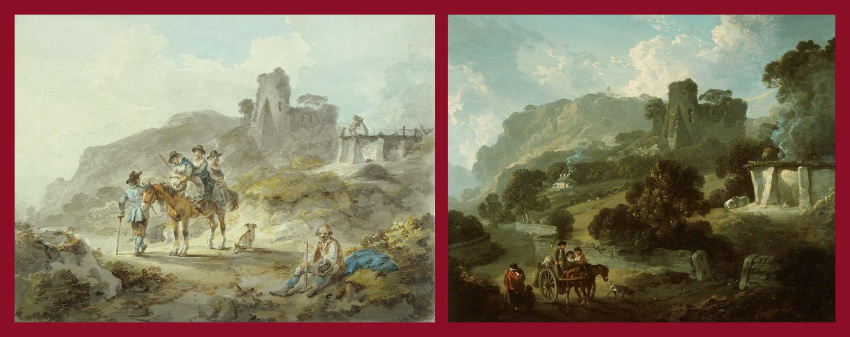
There are several photos in the book from Michael Cradock and John Harris. I don’t have copies of these images so I’ve included some similar ones.
I’ve published quite a few posts about Roger’s books and I’m incredibly grateful for the work he put into creating them. This book features another collection of articles by the editor and other contributors. I’d love to know more about them if you recognise their names.
Contents
Castell Coch before Burges and Bute:
Roger L Brown
Some Reminiscences of Tongwynlais:
Trevor Morgan
Motor Buses through Tongwynlais:
Chris Taylor
Victorian Tongwynlais:
Paul Griffiths
Tongwynlais through the ages:
The Cory’s of Coryton:
Roger L Brown
The Hounds of Pentyrch, once hunted by Mr Lewis of Greenmeadow:
Edwin Pryce
Some further notes on the photographs:
Edited and published by Roger Lee Brown for the Tair Eglwys Press of Tongwynlais 1983.
The previous book, Turn of the Century Ton, returned a profit of £213. This was distributed as follows, in proportion to the number of copies sold:
- St James’ Church, Taffs Well, £22.65:
- Village Hall, Tongwynlais, 178.64.
- SAMS, via St Michael’s Church, £111.89.
Many thanks to those who helped sell these books, especially to Parry’s Manchester Stores.
Some Reminiscences of Tongwynlais
Trevor Morgan
Trevor’s reminiscences include some lovely details about the Tongwynlais Railway Station. I’ve written a couple of posts about the station that include some unique and digitally restored images.

“When the Cardiff Railway opened the villagers were enabled to travel to Cardiff from the station in Tongwynlais. The station was situated north of the park, and was approached from Ironbridge Road or from Market Street and Railway Terrace. The Batter* as we called it still borders the park. The railway bridge^ near the park gates was a fine piece of workmanship, having a span of nearly thirty feet. Rough dressed stone was used for the walls, and a blue brick for the arch. It was demolished when the new Trunk Road was built. The bridge would have put to shame the concrete structures erected today.”
* The slopes on the sides of a railway embankment or cutting
^ There’s a fantastic photo of the bridge from Michael Cradock on the Tongwynlais Historical Society’s Facebook page.
“The station was quite a large one for the village, having two platforms up and down, with an iron footbridge. The station on the up side had the booking hall with the clerk’s office, a comfortable waiting room with a fireplace, table, and seats around the walls; a parcels office, and also a tin shed which I think was used to store larger parcels which would be unloaded in the siding. Oh!, yes, we had a siding!”
He also recounts the visiting fair, “My father, who was known in the village as the woodcutter, would sometimes be asked to do some special job. Sometimes it was a special shaped stay for a caravan, or even a spoke for a wheel.”
Stephen Rowson shared a photo of the fair on Facebook.
Trevor describes the local social activities, “Another aspect on the social side was musical. My earliest recollection was the mixed choir known as Jake Jakeman’s choir. This was a choir of good quality. Its meeting place was Salem chapel. When this choir finished a ladies’ choir was formed still under the baton of Jake Jakeman; this choir kept going for many years.”
Motor Buses through Tongwynlais
Chris Taylor
Chris recounts a fascinating history of public transport from the start of the 20th century.
“Tongwynlais had to wait until October 1920 before it was connected to a motor bus route. In that month The Tresillian Motors Ltd. began a service of charabancs and later double deckers on a service from Pontypridd to Cardiff.”
“In the mid 20s bus services through Tongwynlais settled down to a steady pattern, with more modern vehicles entering service.”
“The next route chosen by the bus operators was the Cardiff-Aberdare one. Two independents, Imperial of Abercynon and Gough of Mountain Ash fought long and hard to obtain this route, especially with Cardiff Corporation, and finally obtained the service in 1928. It became another ‘gold mine’ with buses lined up in Gorsedd Gardens, Cardiff, ready to take people to Aberdare. At this time there was a bus every five minutes in Tongwynlais.”
“This more or less completes the picture of bus operations through the village up to 1931. There was a total of four council and five independent bus operators on routes travelling through Tongwynlais, giving an excellent service never to be repeated.”
“After the 1926 General Strike, during which people had to find other means of getting to work, the railways being completely at a standstill, a large number of people set themselves up as bus and coach operators.
Four such operators were in Tongwynlais:
- William Clifford Davies, 24 Mill Street
- Ottoline C Davies, Wellfield, Merthyr Road
- Walter Phillips, 6 Market Street
- BH Thomas
“The most well known coach operator of the village was the Bennett family, who ran coaches from January 1948 until the end of the 1962 season.”
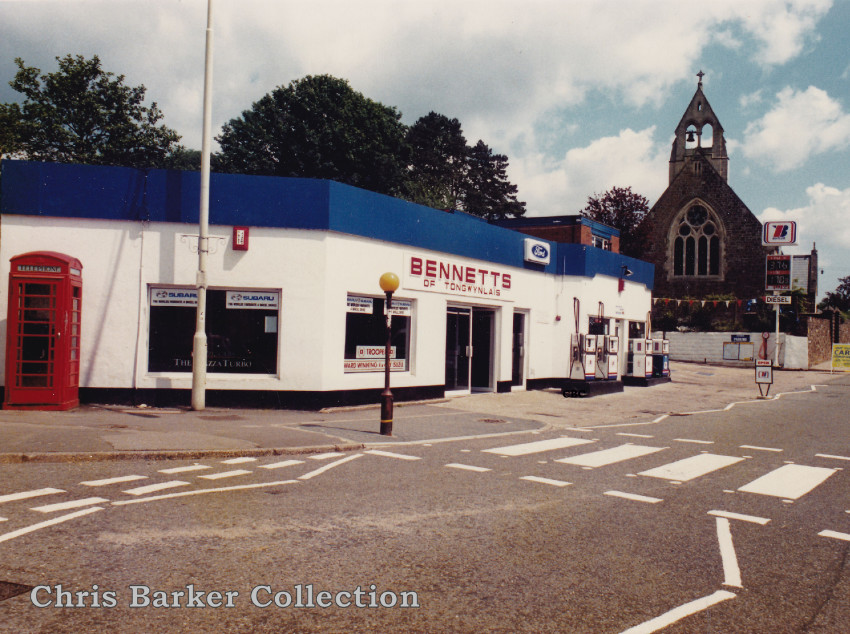
“During 1941 Ernie gave up this work, and moved back to Heol Don, working at the Austin Works in Treforest. Passing daily by bus through Tongwynlais he noticed a garage for sale. It consisted of petrol pumps and cover for two cars. A lease was taken for two years in 1942. Working with his two sons, John and Colin, the garage was built up, and after John had returned from war service and Colin from national service in 1947, they began coaching from the garage in Tongwynlais in January 1948.”
“A very good business was built up from Ton Garage, and the cream and light blue coaches became well known throughout South Wales and beyond.”
Victorian Tongwynlais
Paul Griffiths
Paul contributed a comprehensive history of the village during the Victorian era. He explains the factors that caused this period of incredible growth and change.
“Prior to 1851 Tongwynlais had been nothing more than a sparse settlement depending on the Greenmeadow estate for its employment. The only other employment in the village was as a boatman, on the canal, built in 1790.”

“The next forty years was to see expansion on a scale hitherto never experienced. Melin Griffith, the iron and tin plate rolling mills, was to quadruple its output. The Taff canal was the artery from the Welsh mines and furnaces to Cardiff docks. Tongwynlais was to share in this expansion by virtue of its geographical position, on the banks of the canal.”
“From 1851 to 1871 Tongwynlais underwent considerable expansion, its population quadrupled and the size of the village correspondingly grew.”
“The village expansion seems to be linked to two factors, one, the expansion of Melin Griffith and two, the increased traffic on the canal caused by the general industrial development of South Wales. Yet the village’s growth can only be indirectly linked to Melin Griffith, the increased labour force did not come to live in the village, but rather it seems that the village became a service centre for its labour force.”
The image below shows the Glamorganshire Canal by Samuel Coupe Fox.

“Tongwynlais also experienced a considerable transformation but her development had a slightly different emphasis. It did not develop primarily to house the industrial workers, but more as a service centre for them.”
“In this decade the population had increased by an amazing 218% from 87 people to 277.”
“By the 1871 census the further increase of 40 people was made up primarily of storekeepers, a blacksmith, clergy and publicans. The number of people employed in service industries had doubled since the previous census.”
“The 1870s were a watershed period for Tongwynlais. It was both a time of great prosperity and dramatic change. But it did not last. Economic depression was soon to come. The economic prosperity the area enjoyed during the early part of the 70s can best be illustrated by two projects. The first was the rebuilding of Castell Coch, and the second the experiment of its vineyard. Although the working class enjoyed higher wages during this period, it was the employers who reaped the benefits of increased production, and the Marquess of Bute ploughed much of his profit from his industrial undertakings into these two projects.”
“The depression was to have a lasting effect on the growth of Tongwynlais. The last decades of the 19th century saw the village in a period of stagnation.”
Sources
- “More About Ton” by Roger L Brown – My own collection
- “A Party of Welsh Damsels” – Amgueddfa Cymru – Museum Wales
- Tongwynlais Railway – The Ian L Wright Collection
- Bennett’s Garage – The Chris Barker Collection
- Greenmeadow House – My own collection
- Glamorganshire Canal by Samuel Coupe Fox – Amgueddfa Cymru – Museum Wales
